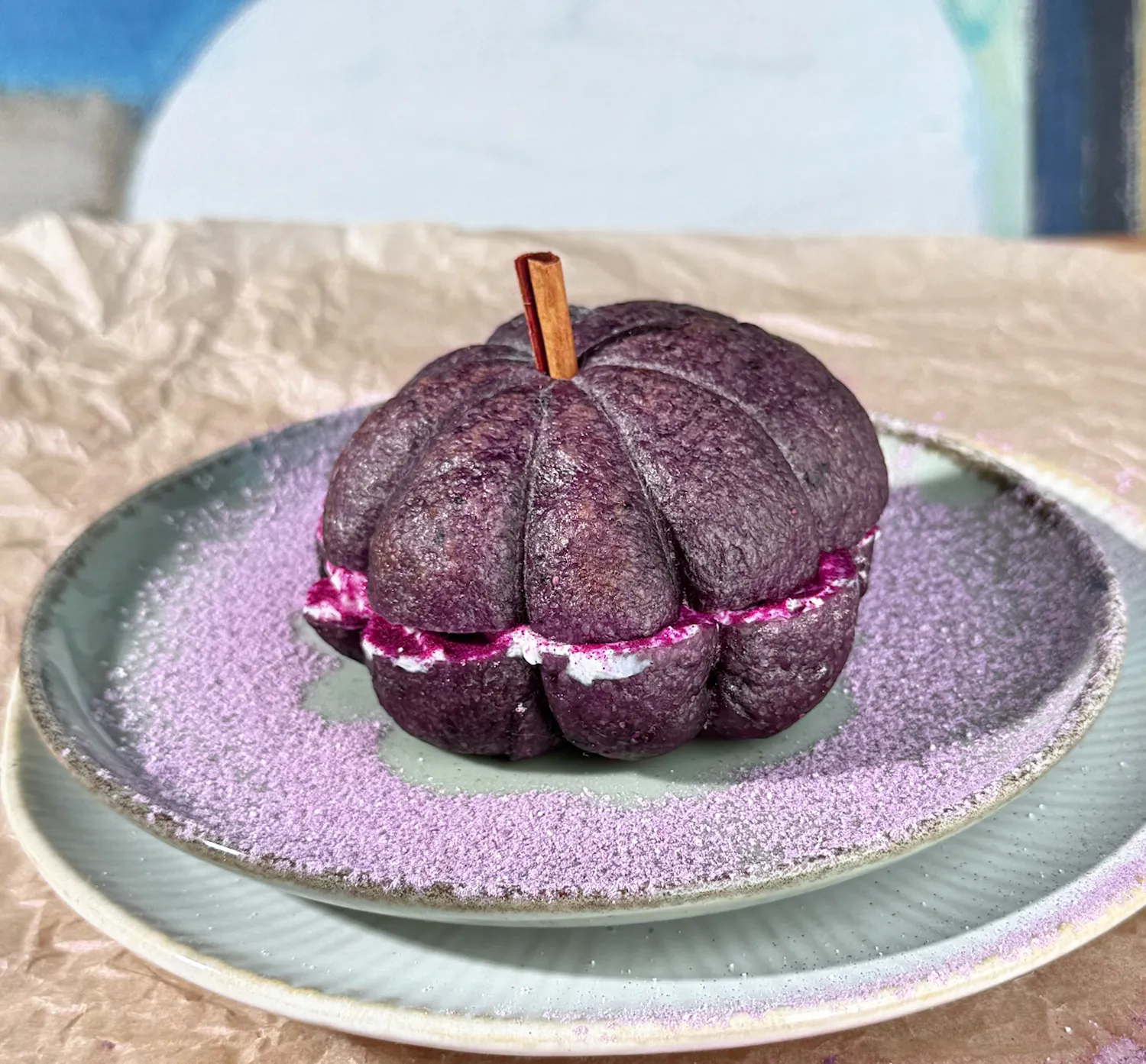
Blueberry Bagels, Purple Inside and Out
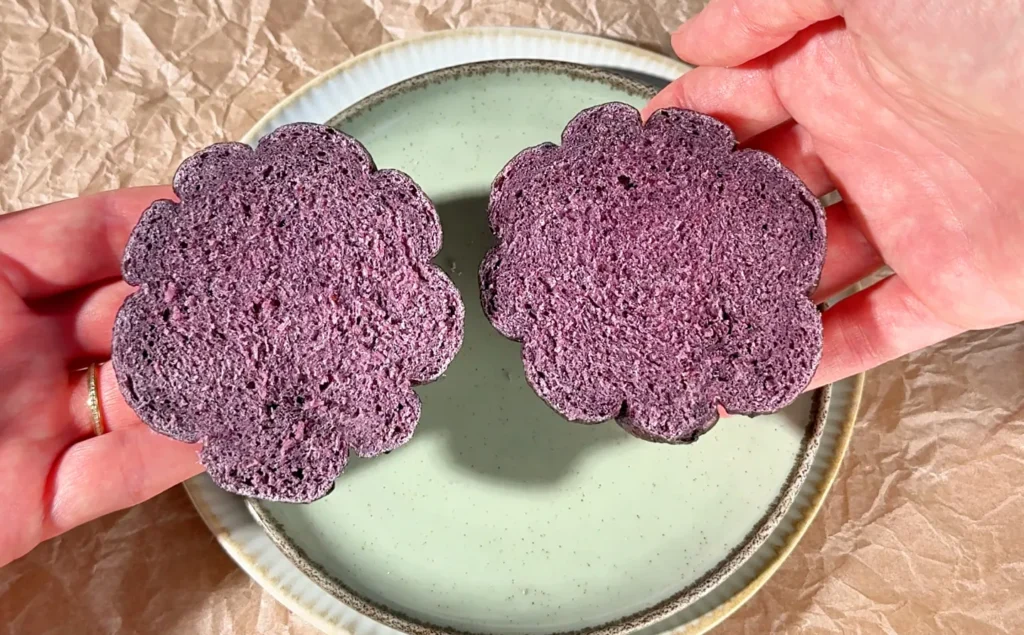
The color in these bagels doesn’t come from any coloring: it’s 300 g (about 2 cups) of blueberries cooked down slowly into a thick puree that goes straight into the dough. The crumb comes out a purple that doesn’t look like something you made at home.
Inside they’re proper bagels: a dense, tender crumb, a glossy crust and that chew that comes from boiling in honey and baking soda water and from a night in the cold. The flavor is a bagel with a fruity note underneath, not sweet and not cloying.
You can shape them two ways with the same dough: round with a hole, like a classic bagel, or tied with kitchen twine so they bake into little pumpkins. In deep purple, the second one needs no explanation for Halloween.
It’s the same dough as our homemade bagels, swapping part of the water for fruit puree. We give you every amount in grams (with cups and spoons in brackets) and explain why each step matters, so they turn out right the first time.
How We Make Them at Home, Step by Step
Blueberry Bagels
Equipment
- Stand mixer with dough hook Strongly recommended: this is a very firm dough
- Saucepan For reducing the puree
- Fine mesh strainer Optional, to remove the blueberry skins
- Pot, about 3.3 L (3½ qt) The wider the pot, the more you can boil at once
- Spider strainer or a medium fine mesh strainer A little wider than the bagels, so you can lift them out whole without bending them. A slotted spoon works too
- Baking sheet Lined with parchment paper
- Kitchen scale
- Probe thermometer Optional, to check 95 °C (203 °F) in the center
Ingredients
Blueberry puree
- 300 g blueberries about 2 cups; fresh or frozen
Dough
- 500 g bread flour about 4 cups, 13-14% protein
- 180 g reduced blueberry puree ¾ cup; at room temperature, 18-22 °C (64-72 °F)
- 125 g water ½ cup; at 20-22 °C (68-72 °F)
- 6 g fresh yeast 0.2 oz; or 2 g (⅔ tsp) instant yeast
- 10 g fine salt 1¾ tsp
- 15 g honey 2 tsp
- 10 g sugar 2½ tsp
Boiling water
- 2000 g water 8½ cups
- 27 g honey 1¼ tbsp
- 5 g baking soda 1 tsp
For the parchment
- 10 g sunflower oil 2 tsp: 5 g for the cold rest and 5 g for the baking sheet
For the pumpkin shape only
- 8 pieces of cotton kitchen twine 80 cm (32 in) each
- 10 g sunflower oil 2 tsp, to rub the twine
- 8 short cinnamon sticks or rosemary sprigs, optional
Instructions
The blueberry puree
- Cook the blueberries down. 300 g (about 2 cups) in a saucepan over medium heat, with no water at all, for 10 to 12 minutes, crushing them with a fork. It's ready when it thickens like a loose jam and the trail of the spoon takes a second to close.
- Blend it. And if you want a smoother crumb and a more even color, push it through a fine mesh strainer to remove the skins.
- Let it cool and weigh it. To room temperature, 18-22 °C (64-72 °F). You should have between 180 and 200 g (¾ to scant 1 cup). If it's over 200 g, give it a few more minutes on the heat.
The dough
- Mix the dry ingredients. In the stand mixer bowl, with the dough hook, add the flour, salt and sugar. Mix for 20 seconds on speed 1.
- Add the liquids and the puree. Dissolve the fresh yeast and the honey in the 125 g (½ cup) of water at 20-22 °C (68-72 °F) and add it to the bowl together with the blueberry puree. If using instant yeast, add it with the dry ingredients instead.
- Knead on two speeds. 3 minutes on speed 1, until no loose flour remains, then 10 to 12 minutes on speed 2. Don't go above speed 2: with a dough this firm, the mixer walks and the motor strains. If that happens, stop for 5 minutes and continue. If you knead by hand, expect it to take considerably longer, with a rest or two along the way: this is a stiff dough.
- Adjust the texture if needed. Every batch of puree is different. If at 5 minutes the dough looks cracked and won't come together, add water 5 g (1 tsp) at a time, up to 20 g (4 tsp). If at 8 minutes it's still stuck to the sides, add flour 10 g at a time: the fruit sugars can leave it a little sticky.
- Check the dough. It's ready when it pulls away from the bowl as a smooth, firm ball. It won't pass the windowpane test, and it doesn't need to. Final dough temperature: 24-25 °C (75-77 °F).
Rising and shaping
- Let it rise for 60 to 90 minutes, covered, at 22-24 °C (72-75 °F). It only grows by 30-40%. Go by volume, not the clock: your kitchen temperature matters more than any time we can give you.
- Divide into 8 pieces of about 105 g (3¾ oz) and shape each into a ball. Flatten each piece into a disc, fold the edges into the center several times, turning the dough as you go, until the surface feels tight, then turn it over with the folds underneath. Let them rest, covered, for 15 minutes.
- Seal the base. Fold again, pressing firmly, and close the underside with small pinches until there are no cracks or creases left. A well-sealed base keeps the bagel from splitting in the water.
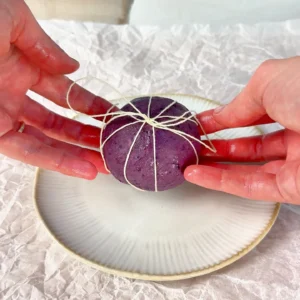
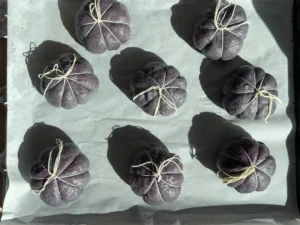
- Shape them, with a hole or as pumpkins. For the classic bagel, push your thumb through the center of the ball, put two fingers in and turn the dough like a steering wheel until the hole is 4 or 5 cm (1½ to 2 in), the same thickness all the way around. It looks like too much, but it closes up by almost half. For the pumpkin shape, skip the hole: rub the 8 pieces of twine with 10 g (2 tsp) of oil, tie each ball into 8 sections and knot it on top without pulling it tight.

- Transfer them to the baking sheet. Onto parchment brushed with 5 g (1 tsp) of oil, 3 to 4 cm (1½ in) apart.
Overnight in the fridge
- Refrigerate for 12 to 18 hours at 4 °C (39 °F), covered. This is what gives the shine, the flavor and the chewy crust, so don't skip it.
Boiling
- Preheat the oven 30 minutes ahead. 230 °C (450 °F) with top and bottom heat, or 210 °C (410 °F) with a fan oven.
- Prepare the baking sheet. Line it with fresh parchment, brush it with the other 5 g (1 tsp) of oil and set it next to the pot, with the strainer and a timer.
- Put the water on. 2000 g (8½ cups) of water in a pot of about 3.3 L (3½ qt).
- Add the honey when it boils. 27 g (1¼ tbsp), stirring until it dissolves.
- Add the baking soda little by little. 5 g (1 tsp), over medium heat: on a rolling boil it can foam up all at once. Wait for the foam to settle and skim off what's left.
- Adjust to a gentle simmer. Small bubbles, no rolling boil, which knocks the bagels out of shape.
- Take out only the batch you're boiling. Keep the rest in the fridge until their turn.
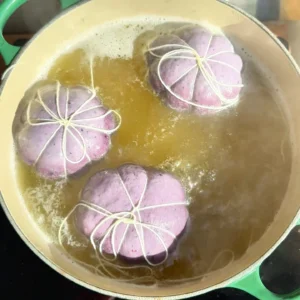
- Boil for 45 seconds. Lower them in with the strainer. You can boil as many as fit in your pot without touching, leaving a little room around them. If they're tied, knot side up.
- Flip them and boil for another 45 seconds. Slide the strainer underneath and, if they're tied, never pull on the twine.
- Drain and return them to the baking sheet. Let them drip over the pot for 5 to 10 seconds, then back onto the sheet about 4 cm (1½ in) apart. If the water has stopped simmering, wait for it to come back before the next batch.

Baking
- Bake at 230 °C (450 °F). 20 to 22 minutes for the pumpkin shape, and 16 to 18 for the ones with a hole, because the heat gets in through the middle too. All together, on the middle rack.
- Check they're done. They sound hollow when tapped underneath, or read 95 °C (203 °F) in the center. Go by that and not by color: the crust is dark from the start.
- Lower to 210 °C (410 °F) if they darken too soon. The fruit sugars make them brown faster. If they're very dark at 12 minutes, continue at that temperature until they pass the previous step.
- Let them cool on a rack. 20 to 30 minutes before splitting them: while warm, the crumb is still setting. If they're tied, remove the twine after 10 minutes by snipping the knot and pulling slowly from one end.
Notes
- 300 g (2 cups) of blueberries give you about 180 g (¾ cup) of puree. If you end up with more than 200 g, it needs a few more minutes on the heat.
- Frozen blueberries work just as well as fresh for the puree.
- The puree has to be at room temperature before it goes into the dough.
- Every batch of puree is different: if the dough looks cracked, add water 5 g (1 tsp) at a time, up to 20 g. If it stays stuck to the sides, flour 10 g at a time.
- The hole closes up by almost half as the dough grows: stretch it to 4 or 5 cm (1½ to 2 in) when shaping.
- The crust comes out much darker than the crumb. That’s the baking soda in the boiling water, which darkens the blueberry pigment on the surface.
- With a bigger pot you can use 3000 g (12¾ cups) of water, 40 g (2 tbsp) of honey and 8 g (1½ tsp) of baking soda, so you can boil more bagels at once.
- For whole berries in the crumb, toss 80 g (½ cup) of frozen blueberries in 10 g (1 tbsp) of flour and fold them in by hand at the end of the kneading.
- Use 100% cotton kitchen twine with no dye. Synthetic string can’t handle the oven temperature.
- For the ube cream cheese filling, the amounts are in the post, below the recipe.
Any questions about the recipe? Ask us in the comments and we’ll get back to you. And if you make it, tell us how it turned out, we love hearing from you! 🤗
Not the Blueberry Bagel You Buy at the Store
Worth saying up front, because it decides whether this recipe is what you’re looking for.
The blueberry bagels on supermarket shelves are pale, with dark specks: they’re made with dried blueberry bits or whole berries folded into a plain dough. These are the opposite. The fruit goes in as a puree, so it tints the whole crumb purple, and there are no specks at all.
Both are good. They’re just not the same thing, and if what you want is the speckled kind, scroll down to the FAQ: we explain how to fold in whole blueberries instead, and you can do both at once.
The Blueberry Puree: Reducing It Is What Changes Everything
Here’s the difference with other fruit bread recipes. Blueberries are mostly water, so if you blend them raw and add them to the dough, two things happen: the dough goes soft and unmanageable, and the color fades to a pale pink that disappears in the oven.
The fix is to cook them with no added water until they thicken. 300 g (about 2 cups) of blueberries give you about 180 g (¾ cup) of puree, so you’re driving off more than a third of their weight in water and concentrating all the pigment into what’s left.
How to know it’s ready. It should look like a loose jam: drag a spoon across the bottom of the pan and the trail takes a second to close. And weigh it, which is the reliable check: if it’s over 200 g, give it a few more minutes.
Straining is optional. Pushing it through a fine mesh strainer removes the skins and gives a smoother crumb and a more even color. If you don’t mind the odd piece of skin, skip it.
Why the dough takes 125 g of water. Reduced puree is still 70-75% water, so those 180 g bring around 130 g. Added to the 125 g (½ cup) you pour in, that’s the 255 g of water in our regular bagel dough, and it ends up just as firm.
Even so, every batch of puree is different and the fruit sugars soften the dough a little, so keep the scale nearby while you knead: if it looks cracked and won’t come together, a little more water 5 g (1 tsp) at a time; if it stays stuck to the sides of the bowl, flour 10 g at a time.
Where the Purple Comes From
All of the color comes from the blueberries. The pigment is called anthocyanin, the same one that colors red cabbage and blackberries, and it has a quirk: its shade shifts with pH.
The crumb stays purple. It’s where the fruit color shows best, and it’s what you see in the cut photo.
The crust goes darker. The boiling water has baking soda in it, which is alkaline, and that pushes the anthocyanin toward a much deeper purple, almost aubergine. The oven dulls it a little more. So it’s normal for the outside to look considerably darker than the inside, and it doesn’t mean they’re overbaked.
If you see bluish or grey glints on the surface at any point, that’s the same thing: the pigment reacting to the baking soda.
Two Shapes, One Dough
The dough is the same and so is the process. Only two things change: how you shape the balls and how long they spend in the oven.
With a hole, the classic bagel. Push your thumb through the center of the ball, put two fingers in and turn the dough like a steering wheel until the hole is 4 or 5 cm (1½ to 2 in). It looks like too much, but it closes up by almost half as the dough grows. Since the heat gets in through the middle too, they bake in 16 to 18 minutes.
Tied into a pumpkin shape, for Halloween. Instead of the hole, you tie each ball with oiled cotton twine into 8 sections and knot it on top without pulling it tight. As the dough grows, it puffs up between the strands and the ridges appear. With no hole the center takes longer, so those go 20 to 22 minutes. The tying, step by step and with photos, is in our pumpkin bagels.
In deep purple, the pumpkin version is one of the best-looking things we’ve pulled out of our oven. The classic one is what you’ll want the rest of the year, especially for splitting and filling.
Why Bagels Are Boiled Before Baking
An unboiled bagel is just a ring-shaped roll. What turns it into a bagel is that short bath in hot water: in 45 seconds per side, the surface of the dough sets into a thin skin. In the oven, that skin becomes the smooth, glossy crust bagels are known for, and it also holds back the rise, which is why the crumb stays dense instead of fluffy.
We put two things in the water:
Honey, for shine.
Baking soda, which makes the water slightly alkaline. The crust browns more and better, and here it’s also what gives the deep purple on the outside.
Keep the water at a gentle simmer, with small bubbles. At a rolling boil the dough gets knocked around and the bagels lose their shape.
We go into it properly in our homemade bagels recipe.
The Night in the Fridge, the Step You Don’t See
Between 12 and 18 hours at 4 °C (39 °F), covered. It looks like a waiting step and nothing more, but it’s where a lot of the work happens: the slow rise develops flavor that two hours at room temperature never will, and cold dough holds its shape far better in the water. It’s also what gives the final shine.
If you want to check they’re ready, take one out of the fridge and drop it into a glass of cold water. If it floats within 10 seconds, go ahead. If it sinks, leave them at room temperature for 30 to 60 minutes and test again.
How We Like to Eat Them: Ube Cream Cheese
Ube is a purple yam, a staple of Filipino baking, and the powdered form is easy to find in Asian grocery stores and online. Stirred into cream cheese it makes a filling as purple as the bread. Per bagel:
- 30 g cream cheese (2 tbsp)
- 1.5 g ube powder (½ tsp)
- 1.5 g powdered sugar (½ tsp)
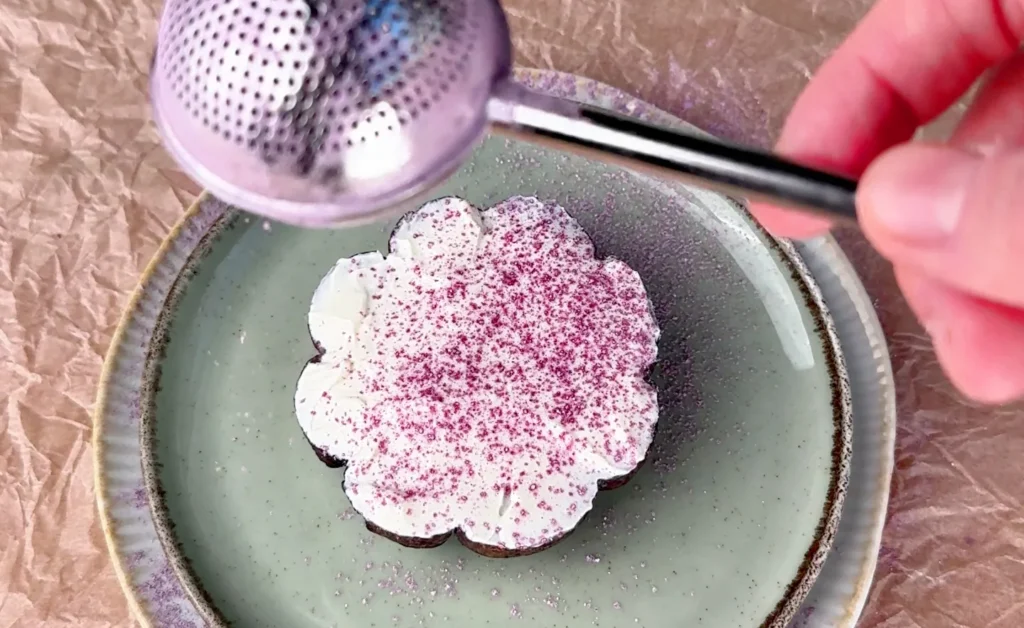
Mix the ube with the powdered sugar first, equal parts. It’s worth making a small jar of it, because it’s the same mix we dust the plate with.
Stir it into the cream cheese. Ube powder is dry and starchy, so the cream cheese firms up more than usual. If it’s hard to spread, a teaspoon of milk or cream brings it back.
Split the bagel once it’s completely cool and spread both halves. While warm, the crumb is still damp inside and squashes as you cut.
The filling gets its color from the ube, not from the blueberries. The bread’s color is all fruit.
If you can’t find ube, cream cheese with blueberry jam works just as well, though the purple is less intense. And if you have puree left over from the dough, a teaspoon stirred into the cream cheese does the same job.
If Something Didn’t Turn Out Right
The crumb came out greyish instead of purple. The puree wasn’t reduced enough, or there wasn’t enough fruit for the amount of flour. 300 g (2 cups) of blueberries should give you about 180 g (¾ cup) of puree, and never more than 200 g.
The crust is much darker than the crumb. That’s normal. The baking soda in the boiling water darkens the pigment on the surface.
The dough is sticky. The fruit sugars soften it. Add flour 10 g at a time until it pulls away from the bowl.
The dough looks cracked and won’t come together. Your puree was on the thick side. Add water 5 g (1 tsp) at a time, up to 20 g (4 tsp).
It hasn’t risen in the time we give. In fermentation, your kitchen temperature matters more than the clock: at 18 °C (64 °F) it can take twice as long as at 24 °C (75 °F). Wait for that 30-40% and carry on, no rush.
The hole closed up. It was too small when you shaped it. Next time, stretch it to 4 or 5 cm (1½ to 2 in).
They lost their shape in the pot. The water was at a rolling boil, or you took them out of the fridge too early and they were soft. Turn the heat down until you only see small bubbles.
The crust came out pale. The oven wasn’t hot enough, or the water was short on baking soda. Preheat for at least 30 minutes.
The stand mixer walks across the counter. Normal with a dough this firm. Stop for 5 minutes and continue, or knead in two rounds of 6 minutes with a 5-minute rest in between.
Frequently Asked Questions About Blueberry Bagels
Can I use frozen blueberries?
Yes, and for the puree they work just as well as fresh. They go straight into the pan, no need to thaw, though they’ll take a couple of minutes longer to cook down.
Why didn’t my crumb come out purple?
Almost always the puree wasn’t reduced enough. Blueberries are mostly water, and if the pigment isn’t concentrated, the color fades in the oven. 300 g (2 cups) of blueberries should give you about 180 g (¾ cup) of puree, and never more than 200 g.
Why is the crust so much darker than the crumb?
That’s normal, and the baking soda in the boiling water does it. Blueberry pigment shifts shade with pH, and in an alkaline bath it goes toward a deep, almost aubergine purple. Inside, where the baking soda doesn’t reach, it keeps the color of the fruit.
Can I make them with whole blueberries instead, like store-bought ones?
Yes, and you can do both at once. Toss 80 g (½ cup) of frozen blueberries in 10 g (1 tbsp) of flour and fold them in by hand at the very end of the kneading, without crushing them. You’ll get dark spots through the crumb on top of the purple.
Can I use blueberry jam instead of puree?
We don’t recommend it for the dough. Jam has sugar and often pectin, so it changes the texture and the rise, and you’d have to recalculate the water. For the filling, though, it’s perfect.
What do you put on a blueberry bagel?
Cream cheese is the classic, and our favorite is cream cheese with ube (we show you how below). Plain butter, honey, or cream cheese with a spoonful of blueberry jam all work beautifully. They’re sweet enough to eat on their own, too.
What is ube powder and where do I buy it?
Ube is a purple yam, a staple of Filipino baking. The powdered form is easy to find in Asian grocery stores and online. If you don’t have it, cream cheese with blueberry jam does a similar job.
Can I use instant or active dry yeast instead of fresh?
Yes. Use 2 g (⅔ tsp) of instant yeast mixed straight into the flour, or about 2.5 g (¾ tsp) of active dry yeast dissolved in the water.
Why add baking soda to the boiling water?
Baking soda makes the water slightly alkaline, which makes the crust brown more and better in the oven. In this recipe it’s also what gives that deep purple on the outside. The honey in the water adds the shine.
Can I skip the night in the fridge?
We don’t recommend it. The cold rise is what gives the shine, the chewy crust and the flavor of a good bagel. It also makes the timing easy: shape them one day, bake them the next.
Can I knead it by hand?
You can, but with a dough this firm it takes real effort and patience. We always use a stand mixer.
How do I store homemade bagels?
They’re at their best the day they’re made. Keep them in a closed bag at room temperature for up to 2 days, or slice and freeze them and toast them straight from the freezer.
Can I make these in an air fryer?
Yes, with a couple of caveats. The boiling doesn’t change, it still happens on the stove; what changes is the baking. An air fryer is a small convection oven: it bakes faster and the element sits much closer, so you’ll need to drop the temperature compared to a regular oven and start checking well before the times in the recipe. Only a few fit at once, so you’ll work in batches. We haven’t baked them this way ourselves yet, so we won’t give you exact numbers: go by the usual test, hollow when tapped underneath or 95 °C (203 °F) in the center. If you try it, tell us in the comments what temperature and time worked for you.
Made This Recipe or Have a Question?
Any questions before you start? Ask us down below and we’ll get back to you. And if you’ve already made it, tell us how it turned out or leave us a rating: it really helps more people find the recipe 😊
Rate this recipe ⭐️